
7.17.2010
7.13.2010
up early
good morning everyone! i'm up and at em early today. we're heading for the redwoods! be back in a few days, hopefully with a cleared out head. don't behave yourselves...

7.11.2010
The Creativity Crisis

How Creative Are You?
The Creativity Crisis
For the first time, research shows that American creativity is declining. What went wrong—and how we can fix it.
by Po Bronson and Ashley Merryman
Newsweek | July 10, 2010
Back in 1958, Ted Schwarzrock was an 8-year-old third grader when he became one of the “Torrance kids,” a group of nearly 400 Minneapolis children who completed a series of creativity tasks newly designed by professor E. Paul Torrance. Schwarzrock still vividly remembers the moment when a psychologist handed him a fire truck and asked, “How could you improve this toy to make it better and more fun to play with?” He recalls the psychologist being excited by his answers. In fact, the psychologist’s session notes indicate Schwarzrock rattled off 25 improvements, such as adding a removable ladder and springs to the wheels. That wasn’t the only time he impressed the scholars, who judged Schwarzrock to have “unusual visual perspective” and “an ability to synthesize diverse elements into meaningful products.”
The accepted definition of creativity is production of something original and useful, and that’s what’s reflected in the tests. There is never one right answer. To be creative requires divergent thinking (generating many unique ideas) and then convergent thinking (combining those ideas into the best result).
In the 50 years since Schwarzrock and the others took their tests, scholars—first led by Torrance, now his colleague, Garnet Millar—have been tracking the children, recording every patent earned, every business founded, every research paper published, and every grant awarded. They tallied the books, dances, radio shows, art exhibitions, software programs, advertising campaigns, hardware innovations, music compositions, public policies (written or implemented), leadership positions, invited lectures, and buildings designed.
Nobody would argue that Torrance’s tasks, which have become the gold standard in creativity assessment, measure creativity perfectly. What’s shocking is how incredibly well Torrance’s creativity index predicted those kids’ creative accomplishments as adults. Those who came up with more good ideas on Torrance’s tasks grew up to be entrepreneurs, inventors, college presidents, authors, doctors, diplomats, and software developers. Jonathan Plucker of Indiana University recently reanalyzed Torrance’s data. The correlation to lifetime creative accomplishment was more than three times stronger for childhood creativity than childhood IQ.

Like intelligence tests, Torrance’s test—a 90-minute series of discrete tasks, administered by a psychologist—has been taken by millions worldwide in 50 languages. Yet there is one crucial difference between IQ and CQ scores. With intelligence, there is a phenomenon called the Flynn effect—each generation, scores go up about 10 points. Enriched environments are making kids smarter. With creativity, a reverse trend has just been identified and is being reported for the first time here: American creativity scores are falling.
Kyung Hee Kim at the College of William & Mary discovered this in May, after analyzing almost 300,000 Torrance scores of children and adults. Kim found creativity scores had been steadily rising, just like IQ scores, until 1990. Since then, creativity scores have consistently inched downward. “It’s very clear, and the decrease is very significant,” Kim says. It is the scores of younger children in America—from kindergarten through sixth grade—for whom the decline is “most serious.”
The potential consequences are sweeping. The necessity of human ingenuity is undisputed. A recent IBM poll of 1,500 CEOs identified creativity as the No. 1 “leadership competency” of the future. Yet it’s not just about sustaining our nation’s economic growth. All around us are matters of national and international importance that are crying out for creative solutions, from saving the Gulf of Mexico to bringing peace to Afghanistan to delivering health care. Such solutions emerge from a healthy marketplace of ideas, sustained by a populace constantly contributing original ideas and receptive to the ideas of others.
It’s too early to determine conclusively why U.S. creativity scores are declining. One likely culprit is the number of hours kids now spend in front of the TV and playing videogames rather than engaging in creative activities. Another is the lack of creativity development in our schools. In effect, it’s left to the luck of the draw who becomes creative: there’s no concerted effort to nurture the creativity of all children.

Around the world, though, other countries are making creativity development a national priority. In 2008 British secondary-school curricula—from science to foreign language—was revamped to emphasize idea generation, and pilot programs have begun using Torrance’s test to assess their progress. The European Union designated 2009 as the European Year of Creativity and Innovation, holding conferences on the neuroscience of creativity, financing teacher training, and instituting problem-based learning programs—curricula driven by real-world inquiry—for both children and adults. In China there has been widespread education reform to extinguish the drill-and-kill teaching style. Instead, Chinese schools are also adopting a problem-based learning approach.
Plucker recently toured a number of such schools in Shanghai and Beijing. He was amazed by a boy who, for a class science project, rigged a tracking device for his moped with parts from a cell phone. When faculty of a major Chinese university asked Plucker to identify trends in American education, he described our focus on standardized curriculum, rote memorization, and nationalized testing. “After my answer was translated, they just started laughing out loud,” Plucker says. “They said, ‘You’re racing toward our old model. But we’re racing toward your model, as fast as we can.’ ”
Overwhelmed by curriculum standards, American teachers warn there’s no room in the day for a creativity class. Kids are fortunate if they get an art class once or twice a week. But to scientists, this is a non sequitur, borne out of what University of Georgia’s Mark Runco calls “art bias.” The age-old belief that the arts have a special claim to creativity is unfounded. When scholars gave creativity tasks to both engineering majors and music majors, their scores laid down on an identical spectrum, with the same high averages and standard deviations. Inside their brains, the same thing was happening—ideas were being generated and evaluated on the fly.
Researchers say creativity should be taken out of the art room and put into homeroom. The argument that we can’t teach creativity because kids already have too much to learn is a false trade-off. Creativity isn’t about freedom from concrete facts. Rather, fact-finding and deep research are vital stages in the creative process. Scholars argue that current curriculum standards can still be met, if taught in a different way.

To understand exactly what should be done requires first understanding the new story emerging from neuroscience. The lore of pop psychology is that creativity occurs on the right side of the brain. But we now know that if you tried to be creative using only the right side of your brain, it’d be like living with ideas perpetually at the tip of your tongue, just beyond reach.
When you try to solve a problem, you begin by concentrating on obvious facts and familiar solutions, to see if the answer lies there. This is a mostly left-brain stage of attack. If the answer doesn’t come, the right and left hemispheres of the brain activate together. Neural networks on the right side scan remote memories that could be vaguely relevant. A wide range of distant information that is normally tuned out becomes available to the left hemisphere, which searches for unseen patterns, alternative meanings, and high-level abstractions.
Having glimpsed such a connection, the left brain must quickly lock in on it before it escapes. The attention system must radically reverse gears, going from defocused attention to extremely focused attention. In a flash, the brain pulls together these disparate shreds of thought and binds them into a new single idea that enters consciousness. This is the “aha!” moment of insight, often followed by a spark of pleasure as the brain recognizes the novelty of what it’s come up with.
Now the brain must evaluate the idea it just generated. Is it worth pursuing? Creativity requires constant shifting, blender pulses of both divergent thinking and convergent thinking, to combine new information with old and forgotten ideas. Highly creative people are very good at marshaling their brains into bilateral mode, and the more creative they are, the more they dual-activate.
Is this learnable? Well, think of it like basketball. Being tall does help to be a pro basketball player, but the rest of us can still get quite good at the sport through practice. In the same way, there are certain innate features of the brain that make some people naturally prone to divergent thinking. But convergent thinking and focused attention are necessary, too, and those require different neural gifts. Crucially, rapidly shifting between these modes is a top-down function under your mental control. University of New Mexico neuroscientist Rex Jung has concluded that those who diligently practice creative activities learn to recruit their brains’ creative networks quicker and better. A lifetime of consistent habits gradually changes the neurological pattern.

A fine example of this emerged in January of this year, with release of a study by University of Western Ontario neuroscientist Daniel Ansari and Harvard’s Aaron Berkowitz, who studies music cognition. They put Dartmouth music majors and nonmusicians in an fMRI scanner, giving participants a one-handed fiber-optic keyboard to play melodies on. Sometimes melodies were rehearsed; other times they were creatively improvised. During improvisation, the highly trained music majors used their brains in a way the nonmusicians could not: they deactivated their right-temporoparietal junction. Normally, the r-TPJ reads incoming stimuli, sorting the stream for relevance. By turning that off, the musicians blocked out all distraction. They hit an extra gear of concentration, allowing them to work with the notes and create music spontaneously.
Charles Limb of Johns Hopkins has found a similar pattern with jazz musicians, and Austrian researchers observed it with professional dancers visualizing an improvised dance. Ansari and Berkowitz now believe the same is true for orators, comedians, and athletes improvising in games.
The good news is that creativity training that aligns with the new science works surprisingly well. The University of Oklahoma, the University of Georgia, and Taiwan’s National Chengchi University each independently conducted a large-scale analysis of such programs. All three teams of scholars concluded that creativity training can have a strong effect. “Creativity can be taught,” says James C. Kaufman, professor at California State University, San Bernardino.
What’s common about successful programs is they alternate maximum divergent thinking with bouts of intense convergent thinking, through several stages. Real improvement doesn’t happen in a weekend workshop. But when applied to the everyday process of work or school, brain function improves.
So what does this mean for America’s standards-obsessed schools? The key is in how kids work through the vast catalog of information. Consider the National Inventors Hall of Fame School, a new public middle school in Akron, Ohio. Mindful of Ohio’s curriculum requirements, the school’s teachers came up with a project for the fifth graders: figure out how to reduce the noise in the library. Its windows faced a public space and, even when closed, let through too much noise. The students had four weeks to design proposals.

Working in small teams, the fifth graders first engaged in what creativity theorist Donald Treffinger describes as fact-finding. How does sound travel through materials? What materials reduce noise the most? Then, problem-finding—anticipating all potential pitfalls so their designs are more likely to work. Next, idea-finding: generate as many ideas as possible. Drapes, plants, or large kites hung from the ceiling would all baffle sound. Or, instead of reducing the sound, maybe mask it by playing the sound of a gentle waterfall? A proposal for double-paned glass evolved into an idea to fill the space between panes with water. Next, solution-finding: which ideas were the most effective, cheapest, and aesthetically pleasing? Fiberglass absorbed sound the best but wouldn’t be safe. Would an aquarium with fish be easier than water-filled panes?
Then teams developed a plan of action. They built scale models and chose fabric samples. They realized they’d need to persuade a janitor to care for the plants and fish during vacation. Teams persuaded others to support them—sometimes so well, teams decided to combine projects. Finally, they presented designs to teachers, parents, and Jim West, inventor of the electric microphone.
Along the way, kids demonstrated the very definition of creativity: alternating between divergent and convergent thinking, they arrived at original and useful ideas. And they’d unwittingly mastered Ohio’s required fifth-grade curriculum—from understanding sound waves to per-unit cost calculations to the art of persuasive writing. “You never see our kids saying, ‘I’ll never use this so I don’t need to learn it,’ ” says school administrator Maryann Wolowiec. “Instead, kids ask, ‘Do we have to leave school now?’ ” Two weeks ago, when the school received its results on the state’s achievement test, principal Traci Buckner was moved to tears. The raw scores indicate that, in its first year, the school has already become one of the top three schools in Akron, despite having open enrollment by lottery and 42 percent of its students living in poverty.
With as much as three fourths of each day spent in project-based learning, principal Buckner and her team actually work through required curricula, carefully figuring out how kids can learn it through the steps of Treffinger’s Creative Problem-Solving method and other creativity pedagogies. “The creative problem-solving program has the highest success in increasing children’s creativity,” observed William & Mary’s Kim.

The home-game version of this means no longer encouraging kids to spring straight ahead to the right answer. When UGA’s Runco was driving through California one day with his family, his son asked why Sacramento was the state’s capital—why not San Francisco or Los Angeles? Runco turned the question back on him, encouraging him to come up with as many explanations as he could think of.
Preschool children, on average, ask their parents about 100 questions a day. Why, why, why—sometimes parents just wish it’d stop. Tragically, it does stop. By middle school they’ve pretty much stopped asking. It’s no coincidence that this same time is when student motivation and engagement plummet. They didn’t stop asking questions because they lost interest: it’s the other way around. They lost interest because they stopped asking questions.
Having studied the childhoods of highly creative people for decades, Claremont Graduate University’s Mihaly Csikszentmihalyi and University of Northern Iowa’s Gary G. Gute found highly creative adults tended to grow up in families embodying opposites. Parents encouraged uniqueness, yet provided stability. They were highly responsive to kids’ needs, yet challenged kids to develop skills. This resulted in a sort of adaptability: in times of anxiousness, clear rules could reduce chaos—yet when kids were bored, they could seek change, too. In the space between anxiety and boredom was where creativity flourished.
It’s also true that highly creative adults frequently grew up with hardship. Hardship by itself doesn’t lead to creativity, but it does force kids to become more flexible—and flexibility helps with creativity.
In early childhood, distinct types of free play are associated with high creativity. Preschoolers who spend more time in role-play (acting out characters) have higher measures of creativity: voicing someone else’s point of view helps develop their ability to analyze situations from different perspectives. When playing alone, highly creative first graders may act out strong negative emotions: they’ll be angry, hostile, anguished. The hypothesis is that play is a safe harbor to work through forbidden thoughts and emotions.

In middle childhood, kids sometimes create paracosms—fantasies of entire alternative worlds. Kids revisit their paracosms repeatedly, sometimes for months, and even create languages spoken there. This type of play peaks at age 9 or 10, and it’s a very strong sign of future creativity. A Michigan State University study of MacArthur “genius award” winners found a remarkably high rate of paracosm creation in their childhoods.
From fourth grade on, creativity no longer occurs in a vacuum; researching and studying become an integral part of coming up with useful solutions. But this transition isn’t easy. As school stuffs more complex information into their heads, kids get overloaded, and creativity suffers. When creative children have a supportive teacher—someone tolerant of unconventional answers, occasional disruptions, or detours of curiosity—they tend to excel. When they don’t, they tend to underperform and drop out of high school or don’t finish college at high rates.
They’re quitting because they’re discouraged and bored, not because they’re dark, depressed, anxious, or neurotic. It’s a myth that creative people have these traits. (Those traits actually shut down creativity; they make people less open to experience and less interested in novelty.) Rather, creative people, for the most part, exhibit active moods and positive affect. They’re not particularly happy—contentment is a kind of complacency creative people rarely have. But they’re engaged, motivated, and open to the world.
The new view is that creativity is part of normal brain function. Some scholars go further, arguing that lack of creativity—not having loads of it—is the real risk factor. In his research, Runco asks college students, “Think of all the things that could interfere with graduating from college.” Then he instructs them to pick one of those items and to come up with as many solutions for that problem as possible. This is a classic divergent-convergent creativity challenge. A subset of respondents, like the proverbial Murphy, quickly list every imaginable way things can go wrong. But they demonstrate a complete lack of flexibility in finding creative solutions. It’s this inability to conceive of alternative approaches that leads to despair. Runco’s two questions predict suicide ideation—even when controlling for preexisting levels of depression and anxiety.

In Runco’s subsequent research, those who do better in both problem-finding and problem-solving have better relationships. They are more able to handle stress and overcome the bumps life throws in their way. A similar study of 1,500 middle schoolers found that those high in creative self-efficacy had more confidence about their future and ability to succeed. They were sure that their ability to come up with alternatives would aid them, no matter what problems would arise.
When he was 30 years old, Ted Schwarzrock was looking for an alternative. He was hardly on track to becoming the prototype of Torrance’s longitudinal study. He wasn’t artistic when young, and his family didn’t recognize his creativity or nurture it. The son of a dentist and a speech pathologist, he had been pushed into medical school, where he felt stifled and commonly had run-ins with professors and bosses. But eventually, he found a way to combine his creativity and medical expertise: inventing new medical technologies.
Today, Schwarzrock is independently wealthy—he founded and sold three medical-products companies and was a partner in three more. His innovations in health care have been wide ranging, from a portable respiratory oxygen device to skin-absorbing anti-inflammatories to insights into how bacteria become antibiotic-resistant. His latest project could bring down the cost of spine-surgery implants 50 percent. “As a child, I never had an identity as a ‘creative person,’ ” Schwarzrock recalls. “But now that I know, it helps explain a lot of what I felt and went through.”
Creativity has always been prized in American society, but it’s never really been understood. While our creativity scores decline unchecked, the current national strategy for creativity consists of little more than praying for a Greek muse to drop by our houses. The problems we face now, and in the future, simply demand that we do more than just hope for inspiration to strike. Fortunately, the science can help: we know the steps to lead that elusive muse right to our doors.
7.06.2010
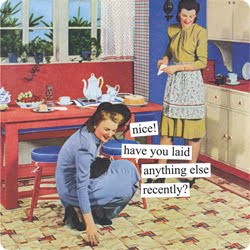
so Sue me

10 Easy Steps for Becoming a Radical Homemaker
Go on and live dangerously -- hang out the wash.
Shannon Hayes wrote this for YES! Magazine
When I first released Radical Homemakers: Reclaiming Domesticity from a Consumer Culture, I was advised to make a list of “easy steps for becoming a radical homemaker” as part of my publicity outreach materials. My shoulders slumped at the very thought: Three years of research about the social, economic, and ecological significance of homemaking, and I had to reduce it to 10 easy tips? I didn’t see a to-do list as a viable route to a dramatic shift in thinking, beliefs, and behaviors. But since the objective of such a list was smoother discussion and communication of Radical Homemaking ideas with the public, I did it.
 I came up with the simplest things I could imagine—like committing to hanging laundry out to dry, dedicating a portion of the lawn to a vegetable garden, making an effort to get to know neighbors to enable greater cooperation and reduce resource consumption. I would perfunctorily refer back to them when radio dialogues flagged, when interviews seemed to be getting off track, or to distract myself when an occasional wave of personal sarcasm (I do have them on occasion) threatened to jeopardize an otherwise polite discourse about the book. After about 40 media interviews, I was pretty good at rattling them off, and I began to see their power and significance beyond helping me to be polite.
 Take hanging out the laundry as an example. At the outset, it is deceptively simple: It saves money and resources, and it’s easy. As I spoke about line-drying laundry more, however, the suggestion took on more meaning. Of course everyone would like to hang out the laundry. But many people don’t do it. They’re too busy. Thus, the commitment to hanging out the laundry represents a commitment to slowing down—it means starting to align one’s daily household activity with the rhythms of nature. In my mind, hanging out the laundry moved from being a simple chore to being an act of meditation and reflection on a deeper, more profound commitment that a person wanted to make. Thus, draping shirts and socks on a clothesline wasn’t just about getting a chore done; it represented the new, sane world so many of us are working to create. Every time a person sticks a clothespin on a pair of undies, he or she is saying, “I want a better world. And I’m willing to do what it takes.” Laundry may be a simple first step, but it ultimately leads to something bigger.
 Laundry became the central theme of a talk I gave recently in an affluent community, where golf course-quality lawns are ready at a moment’s notice as the backdrop for the season’s latest fad: large screen outdoor television sets. I was speaking at a community eco-festival, where volunteers were teaching residents about the importance of composting, solar panels, buying locally, and changing light bulbs. In my session, I talked about the power of living by one’s values, the misery of excessive consumption, the importance of social change, the deep fulfillment and happiness that results from living with less and having more.
 To help me drive my point home, my husband Bob armed me with a seemingly endless collection of images of fellow radical homemaker’s lives: pictures of happy kids showing off their homemade toys, families gathering for feasts, piles of tomatoes on a kitchen counter following an early fall harvest, a sink full of grapes ready for juicing, friends in their backyard gardens, smiling bike riders. At the end of my talk, I was presented with a single question from a man wearing an expensive watch: “Americans fall on a spectrum with money,” he explained, holding his hands about a foot apart from each other. “Most of the people you’re talking about fall on this end,” he said, waving one hand. “And what you’re talking about may work for them. But what about those of us on this end?” With that, he waved his other hand. “What are we supposed to do to be able to live like that?”
 There were a number of snarky remarks on the end of my tongue. But this man’s eyes were earnest. Perhaps he saw something in those slides that his affluence could not buy. Nevertheless, my sarcasm propensity meter was no longer registering on the dial. It was time to switch to the safety zone and draw from my 10 easy tips: “Grow some vegetables in your backyard. Try learning how to can,” I chirped at him. Once I re-gained my bearings, I talked about changing the world by moving toward what we love, not running away from what we fear. I talked about the power of small changes to result in a deep personal shift. I suggested he hang out the laundry.
 There were no further questions. People politely thanked me for my time and left the room. One other man, who sat in the back corner, lingered. A longtime activist, he expressed his despair at the lifestyles of his neighbors. The social pressure to have a perfect lawn is huge, he explained. For years, he’d been doing programs to encourage residents to allow parts of their lawn to go wild for habitat—an even simpler step than gardening. The majority of his efforts were unsuccessful. There was too much shame. “It’s so much easier for you,” he lamented. “You can hang out the laundry.” I gave him a quizzical look. He went on to explain local zoning codes. By law, people in his community weren’t allowed to hang clothes outside. It was trashy. It would diminish property values.
 But what about home values? I felt deeply sad for his neighbors. They’d devoted their life energy in pursuit of the material affluence required to live in this particular community. At the same time, the number of people in attendance at this eco-festival suggested they truly wanted to play a role in healing the planet. Ironically, the very laws of their community—both social and written—compelled them to turn their backs on their personal values. Henry David Thoreau’s observations about the imprisonment of wealth were spot on: “The opportunities for living are diminished in proportion as what are called the ‘means’ are increased,” he wrote. That day, I saw people who cared about the Earth, who wanted a better world. But their power to act according to these concerns was limited to their purchases alone—to buying solar panels, buy local campaigns, buying new light bulbs. They could try to buy some of their beliefs. But they couldn’t live them.
 I suppose that is the deepest wealth in the radical homemaking lifestyle. By needing less, we are free to live our beliefs. To us, this seems ordinary. To someone else, a values-driven lifestyle might seem an extraordinary act of bravery.
We need that bravery. Now. Worrying about our planet while adhering to local zoning codes or social norms forbidding ecologically sensible behavior is a recipe for disaster. Such laws require citizens to commit an ecological injustice by using a disproportionate share of our Earth’s resources. They scream out for civil disobedience. As Thoreau reminds us, “break the law. Let your life be a counter friction to stop the machine.” Go on and live dangerously. Hang out the wash.
For those who might be curious:
10 Easy Steps for Becoming a Radical Homemaker
- Commit to hanging your laundry out to dry.
- Dedicate a portion of your lawn to a vegetable garden.
- Get to know your neighbors. Cooperate to save money and resources.
- Go to your local farmers' market each week before you head to the grocery store.
- Do some spring cleaning to identify everything in your home that you absolutely don’t need. Donate to help others save money and resources.
- Make a commitment to start carrying your own reusable bags and use them on all your shopping trips.
- Choose one local food item to learn how to preserve for yourself for the winter.
- Get your family to spend more evenings at home, preferably with the TV off.
- Cook for your family.
- Focus on enjoying what you have and who you are with. Stop fixating on what you think you may need, or how things could be better "if only."
 Shannon Hayes wrote this article for YES! Magazine, a national, nonprofit media organization that fuses powerful ideas with practical actions. Shannon is the author of Radical Homemakers: Reclaiming Domesticity from a Consumer Culture, The Grassfed Gourmet and The Farmer and the Grill.
She is the host of grassfedcooking.com and radicalhomemakers.com. Hayes works with her family on Sap Bush Hollow Farm in Upstate New York.

Anne Taintor's Modern Office Revisited
Artist seeks out the models who inspired her comic collages
Suzi Homemaker (all grown up and then some)
The Brainwashing of Suzy Homemaker
Aspiring Homemaker

7.05.2010
the other independence day
We hold these truths to be self-evident:
that all men and women are created equal.
The Other Independence Day
by Robyn Blumner
The Salt Lake Tribune | July 5, 2010
Women have an Independence Day, too. Seneca Falls, N.Y., was the place of our declaration’s signing, a community of reformers and abolitionists in pastoral western New York, not far from the homes of William Seward and Harriet Tubman. Here, the organizers of the First Women’s Rights Convention on July 19-20, 1848, imagined a just future for their daughters, just as decades earlier, in steamy Philadelphia, Jefferson, Franklin and Adams envisioned one for their sons.
The document they produced, the Declaration of Sentiments, bears the signatures of then 32-year-old Elizabeth Cady Stanton (who refused to vow “to obey” in her marriage ceremony) and Lucretia Mott, along with dozens of other women and men. To most of us, the prose of their declaration will ring a (liberty) bell. It begins, “When, in the course of human events ... “ and states “We hold these truths to be self-evident: that all men and women are created equal.” (Emphasis added.)
Whether it’s 1776 or 1848, ideas don’t get much more radical than that.
The declaration’s list of abuses and usurpations were not that of the long-dead King George but of male society that usurped the rights of women and subjugated women within marriage. Women could not vote; married women could not own property; they were denied higher education, and their husbands had legal dominion over them.
The law viewed women as little better than children, much like the way a king sees his subjects. These ladies’ parallel to the rebellion of the founders was more than apt.
As a kid with a healthy sense of right and wrong, I remember being both outraged and befuddled over the battle American women waged for suffrage. Women won the right to vote only 41 years before I was born. By Aug. 26, 1920, the day the 19th Amendment became law, American cities were so jammed with cars and trucks that the traffic light had been invented. Albert Einstein had already posited his general theory of relativity, and modern warfare included the use of airplanes.
Even as illiterate and criminal men enjoyed the franchise, highly educated American women continued to be denied it, decade after decade.
As a girl, I wondered how that could be. But now that my jaundiced eyes have seen the jealous nature of power and privilege, and the stinginess of so many who possess it, I don’t wonder anymore. Here is just a taste of entrenched male entitlement that passed as benevolent paternalism, found in a 1915 editorial in The New York Times titled “The Woman Suffrage Crisis”:
“The grant of suffrage to women is repugnant to instincts that strike their roots deep in the order of nature. It runs counter to human reason, it flouts the teachings of experience and the admonitions of common sense. Although women have other capacities ... they have never possessed or developed the political faculty. Without the counsel and guidance of men, no woman ever ruled a State wisely and well. The defect is innate and one for which a cure is both impossible and not to be desired.”
The editorial goes on to worry about women losing their “many precious privileges” if they enter the “hurly-burly of life.”
At the time this was written, nearly one in four women over the age of 10 was employed. In factories, they earned 25 to 67 percent less than men. Four years before this editorial, 146 garment workers including over 100 women died in the Triangle Shirtwaist Factory fire in New York City, many of them unable to escape the flames because the exits were locked. Where were those precious privileges women would give up if they had a say in government?
We all know that Thomas Jefferson’s Declaration of Independence was an incomplete manifesto, leaving out many from its guarantees of “life, liberty and the pursuit of happiness.” The women and men who congregated at Seneca Falls filled in the largest remaining gap, and in doing so, they laid the foundation for the remarkable advancements of all women to come.
Independence Day comes twice for Elena Kagan, Nancy Pelosi and all the work-a-day women of this country. Seneca Falls started a revolution, and we’re still living it.
Women's Suffrage
that all men and women are created equal.

The Other Independence Day
by Robyn Blumner
The Salt Lake Tribune | July 5, 2010
Women have an Independence Day, too. Seneca Falls, N.Y., was the place of our declaration’s signing, a community of reformers and abolitionists in pastoral western New York, not far from the homes of William Seward and Harriet Tubman. Here, the organizers of the First Women’s Rights Convention on July 19-20, 1848, imagined a just future for their daughters, just as decades earlier, in steamy Philadelphia, Jefferson, Franklin and Adams envisioned one for their sons.
The document they produced, the Declaration of Sentiments, bears the signatures of then 32-year-old Elizabeth Cady Stanton (who refused to vow “to obey” in her marriage ceremony) and Lucretia Mott, along with dozens of other women and men. To most of us, the prose of their declaration will ring a (liberty) bell. It begins, “When, in the course of human events ... “ and states “We hold these truths to be self-evident: that all men and women are created equal.” (Emphasis added.)
Whether it’s 1776 or 1848, ideas don’t get much more radical than that.
The declaration’s list of abuses and usurpations were not that of the long-dead King George but of male society that usurped the rights of women and subjugated women within marriage. Women could not vote; married women could not own property; they were denied higher education, and their husbands had legal dominion over them.
The law viewed women as little better than children, much like the way a king sees his subjects. These ladies’ parallel to the rebellion of the founders was more than apt.
As a kid with a healthy sense of right and wrong, I remember being both outraged and befuddled over the battle American women waged for suffrage. Women won the right to vote only 41 years before I was born. By Aug. 26, 1920, the day the 19th Amendment became law, American cities were so jammed with cars and trucks that the traffic light had been invented. Albert Einstein had already posited his general theory of relativity, and modern warfare included the use of airplanes.
Even as illiterate and criminal men enjoyed the franchise, highly educated American women continued to be denied it, decade after decade.
As a girl, I wondered how that could be. But now that my jaundiced eyes have seen the jealous nature of power and privilege, and the stinginess of so many who possess it, I don’t wonder anymore. Here is just a taste of entrenched male entitlement that passed as benevolent paternalism, found in a 1915 editorial in The New York Times titled “The Woman Suffrage Crisis”:
“The grant of suffrage to women is repugnant to instincts that strike their roots deep in the order of nature. It runs counter to human reason, it flouts the teachings of experience and the admonitions of common sense. Although women have other capacities ... they have never possessed or developed the political faculty. Without the counsel and guidance of men, no woman ever ruled a State wisely and well. The defect is innate and one for which a cure is both impossible and not to be desired.”
The editorial goes on to worry about women losing their “many precious privileges” if they enter the “hurly-burly of life.”
At the time this was written, nearly one in four women over the age of 10 was employed. In factories, they earned 25 to 67 percent less than men. Four years before this editorial, 146 garment workers including over 100 women died in the Triangle Shirtwaist Factory fire in New York City, many of them unable to escape the flames because the exits were locked. Where were those precious privileges women would give up if they had a say in government?
We all know that Thomas Jefferson’s Declaration of Independence was an incomplete manifesto, leaving out many from its guarantees of “life, liberty and the pursuit of happiness.” The women and men who congregated at Seneca Falls filled in the largest remaining gap, and in doing so, they laid the foundation for the remarkable advancements of all women to come.
Independence Day comes twice for Elena Kagan, Nancy Pelosi and all the work-a-day women of this country. Seneca Falls started a revolution, and we’re still living it.
Women's Suffrage

7.04.2010
the very idea
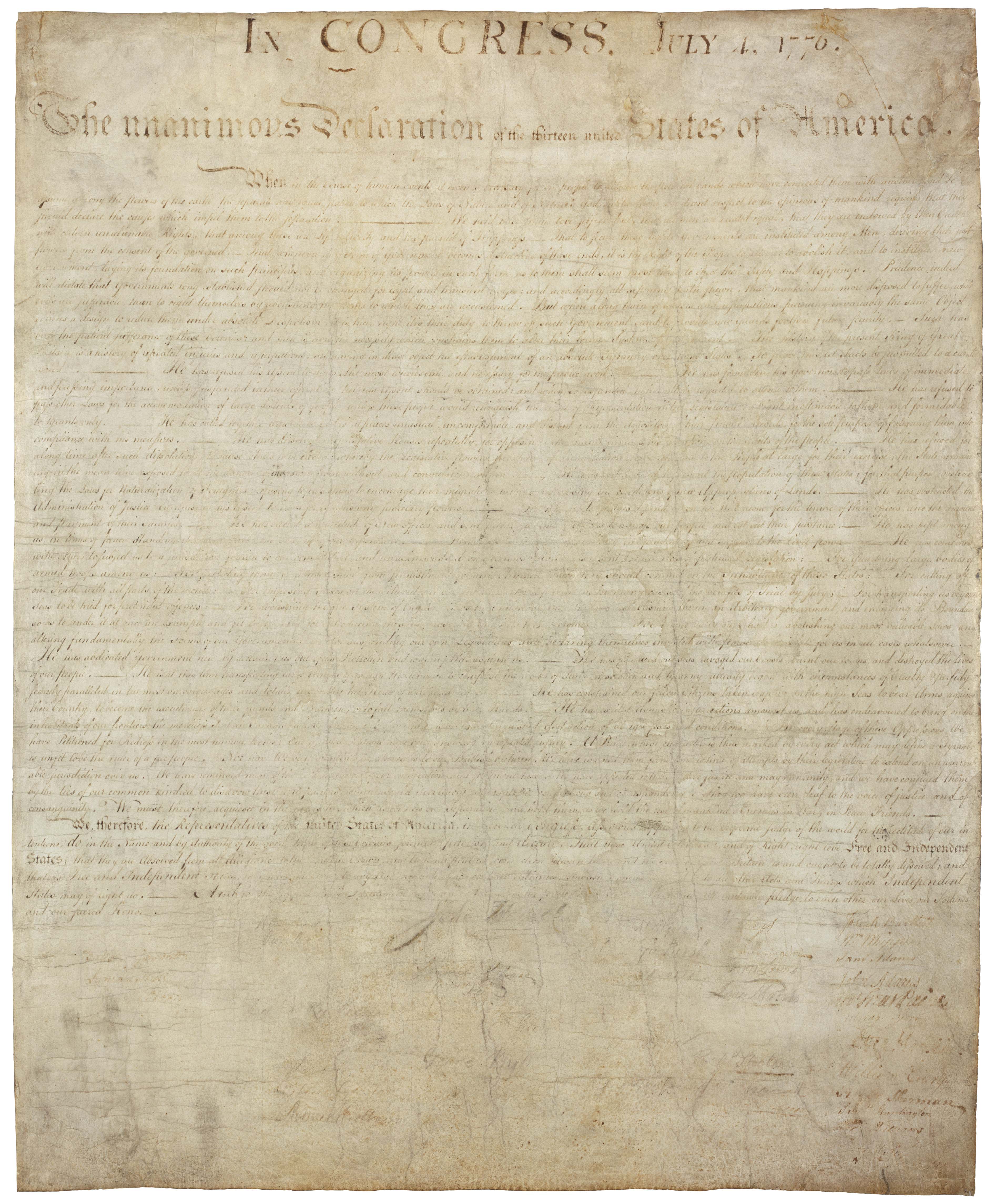
We hold these truths to be self-evident, that all men are created equal, that they are endowed by their Creator with certain unalienable Rights, that among these are Life, Liberty and the pursuit of Happiness.
Thomas Jefferson, Author of The Declaration of Independence
Thomas Paine, the Man Who Galvanized Independence
The U.S. National Archives and Records Administration
The Charters of Freedom
Transcription of the Declaration of Independence
Watch: John Adams - Congress Approving Independence
Watch: Reading The Declaration in Independence Hall

Thomas Jefferson, Author of The Declaration of Independence
Thomas Paine, the Man Who Galvanized Independence
The U.S. National Archives and Records Administration
The Charters of Freedom
Transcription of the Declaration of Independence
Watch: John Adams - Congress Approving Independence
Watch: Reading The Declaration in Independence Hall

7.01.2010
open that door, mr. president
Mankind will never see an end of trouble until lovers of wisdom come to hold political power, or the holders of power become lovers of wisdom. --Plato

A little light reading for you, this first day of July, from professor of political science at Hofstra University, David Michael Green. Okay, it's as light as lead and it's long. But it's strong. And who couldn't use a little strength right now?
Go ahead, find out how, then run outside and seize the day - it's a sunny one!
Postscript:
Apparently one of your fellow followers saw this, got mad and took off. heh. Well it makes me mad too. It should. Time to get mad and yell like hell...
A little light reading for you, this first day of July, from professor of political science at Hofstra University, David Michael Green. Okay, it's as light as lead and it's long. But it's strong. And who couldn't use a little strength right now?
How’s That Recessioney, Oily Thing Working Out For Ya?
Let's be honest: We live in stunningly, jaw-droppingly, ridiculously absurd political times.
Here's the story in a nutshell: A far-right predatory overclass has spent the last thirty years undoing the hard-fought gains of the mid-twentieth century, which had produced a robust middle class and vastly more economic and social justice in America than the country had ever known before. These regressives used every kind of deceit imaginable to persuade unsophisticated voters to choose candidates whose real agenda was to assist their plutocratic puppetmasters in fleecing the very same people who voted for them.
Such candidates ran on issues like the death penalty, immigration, bogus wars, gay marriage and abortion. But what they really were about as legislators was exporting jobs to where workers are dirt cheap and politically neutered, crashing organized labor, shifting the tax burden onto the mass public, deregulating industry to allow unhindered profit-taking on the upside and socialized public responsibility for risk on the downside, and locking in a Supreme Court majority that would never blanch at even the most outrageous rulings enhancing corporate power in American society.
If the product of this slow and silent coup wasn't so bloody and so ruinous to so many lives, you'd really have to hand it to these guys for their political acumen and patience. It took a while, and it required the building of a broad and robust infrastructure, spanning from mainstream media to talk radio and TV to think-tanks to Congress, the presidency and the judiciary, to the GOP and now to the Democratic Party as well, but they have pretty much completely succeeded in grabbing all the levers of power in our society.
How on earth did this happen? continue reading
Go ahead, find out how, then run outside and seize the day - it's a sunny one!
Postscript:
Apparently one of your fellow followers saw this, got mad and took off. heh. Well it makes me mad too. It should. Time to get mad and yell like hell...
Subscribe to:
Posts (Atom)


